

Cadmium, lead, mercury… They’re often referred to as “heavy metals”, and yet the heaviest thing about them isn’t their mass: it’s their capacity to accumulate over time and take their toll on health when they’re only dealt with once the problem has set in. 1 2
The reality is that we live in an environment where background exposure has become almost permanent: air, water, food, domestic dust, materials, industrial activities… 1 2
Why prevention has become essential
In environmental health, prevention is not a “wellness bonus”. It is a logical strategy, because some heavy metals are eliminated very slowly. 3
Heavy metals such as cadmium for example, are so-called cumulative toxins: they can remain in the body for a long time, particularly in the kidneys and liver, with a biological half-life of up to several decades. 3
Consequence: if we wait for intoxication to occur (symptoms, very high levels of analysis, organ damage), we often find ourselves dealing with a more complex, longer-lasting and sometimes only partially reversible problem. 2 3
Heavy metals: what exactly are we talking about?
The term “heavy metals” is mostly a shorthand. In practice, the most closely monitored for exposure of the general public include:
- – Cadmium (Cd): exposure often via the diet (and via tobacco), with possible accumulation in the body. 1 3 4
- – Lead (Pb): exposure linked to certain persistent sources (dust, pipes, old paint, plumbing, industrial activities). 5 6
- – Mercury (Hg): of particular concern in the form of methylmercury, with exposure mainly linked to consumption of contaminated fish and seafood. 7 8
Each has its own sources, mechanisms and “target” organs. But they all have one thing in common: repeated low-dose exposure can become a concern, especially when added to other environmental pollutants. 1 2
Where does daily exposure hide?
1) In food
For cadmium, health organizations indicate that food is a major source of exposure for non-smokers. 1 4
For mercury, vigilance is focused on methylmercury, and recommendations target pregnancy and early childhood in particular (while maintaining a reasonable consumption of fish, as it also has benefits). 7 8
2) In water
Lead can contaminate drinking water via lead-containing plumbing fixtures (depending on installation and age). 6
3) In air and dust
Metals can be emitted into the air by certain industrial activities and then fall back into the environment. European agencies monitor these releases and point out that exposure to high levels can affect ecosystems and human health. 9
4) Via tobacco (a key point for cadmium)
Tobacco is cited as a major source of cadmium exposure. 1 4
Prevent rather than suffer: a 3-level strategy
Level 1 – Reduce sources (the most powerful lever)
- Stop smoking (and limit exposure to smoke). 1 4
- Vary your diet (diversify sources and origins). 10 2
- Fish: apply precautionary recommendations for the most contaminated species in sensitive populations. 8 7
- Water: identify risks (plumbing) and use appropriate/certified filtration solutions if necessary. 6
Level 2 – Supporting the body’s natural defenses
Without falling into the illusion of “all detox”, the body has continuous mechanisms: liver, intestines, kidneys.
In the case of cadmium, we know that it binds strongly to certain proteins (including metallothionein), which contributes to its retention and slow elimination 3
In terms of nutrition, certain elements (e.g. zinc, iron, calcium, depending on the context) can influence the intestinal absorption of certain metals. The ATSDR (Agency for toxic substances and disease Registry) mentions in particular that the presence of zinc and other elements in the diet can reduce cadmium absorption. 3
Level 3 – Taking action in the gut: the “trapping” principle
A very concrete part of prevention is to help the body capture what’s in the digestive tract (what comes in through food… and also what’s excreted via the bile), in order to promote elimination via the stool. 3
This is where certain natural ingredients come into their own, particularly those whose structure can adsorb undesirable substances.
Focus on chlorella: why it’s often cited for prevention
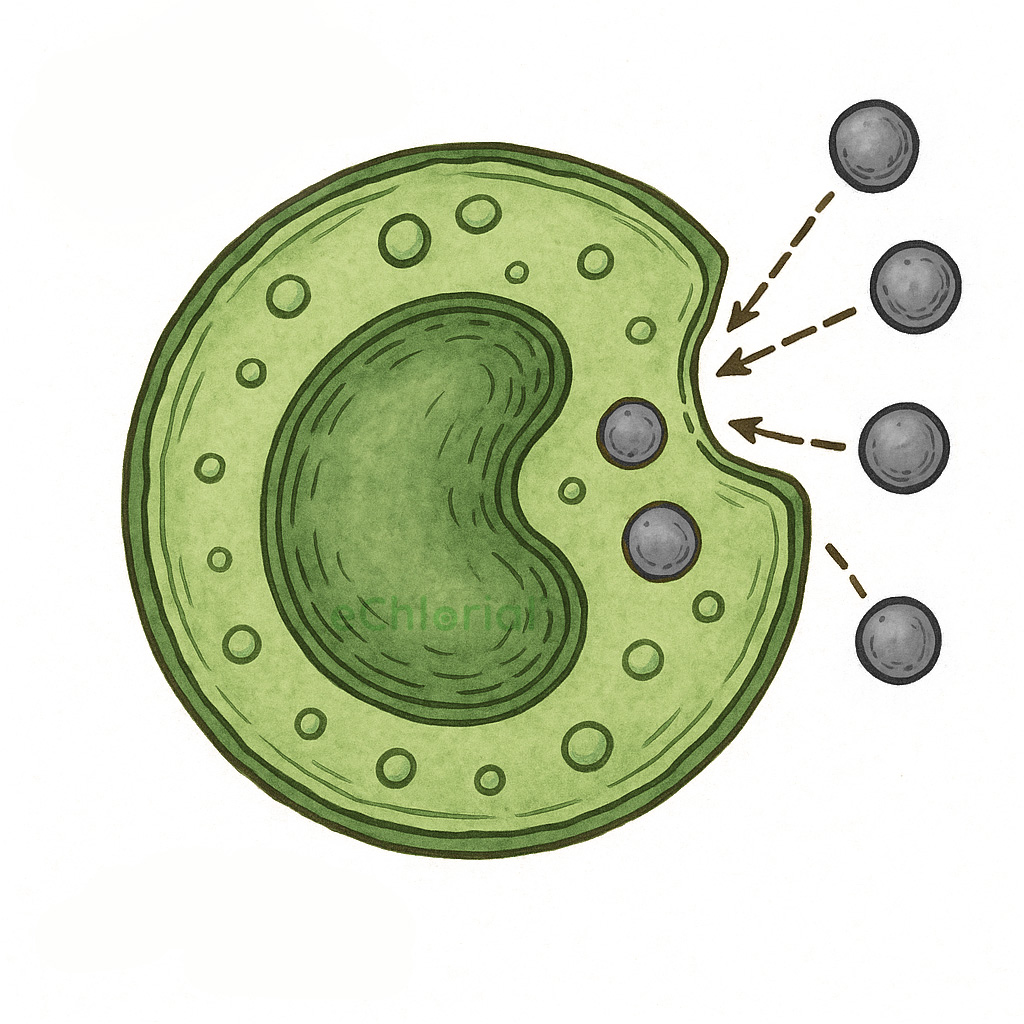
Chlorella is a freshwater microalgae used as a food/complement, known for its nutritional quality (chlorophyll, proteins, micronutrients, fiber…).
But what interests us here is above all this: microalgae have a biosorption capacity (they can bind certain metals to their surface), a property well documented in the literature, notably on the capture of cadmium in aqueous environments. 11
Key idea: in prevention, the aim is not to “magically remove” metals already stored throughout the body, but to reduce the burden of exposure and support physiological elimination pathways, particularly via the intestine. 3 11
How does “detox“works
The action can be summarized in 4 stages:
- Exposure: food, water, air, dust… 1 2
- Absorption: a fraction passes the intestinal barrier (variable according to metal and context). 3
- Storage/binding: some metals bind to proteins and accumulate (cadmium: kidneys/liver; slow elimination). 3
- Elimination: urine + feces, with transit, hydration and what may be “trapped” in the intestine playing an important role. 3
What science says about chlorella and metals
In a study of rats exposed to cadmium, supplementation with chlorella was associated with an increase in fecal and urinary cadmium excretion and a decrease in tissue accumulation. 12
Mercury (methylmercury)
In healthy volunteers, an open clinical trial showed that chlorella supplementation (9 g/d for 3 months) was associated with a decrease in mercury measured in hair (and a trend in blood), suggesting an effect on methylmercury load. 13
How to use chlorella for prevention
Regularity & progressiveness
When it comes to prevention, we generally aim for regular intake (rather than a “shock cure”). Many people start with a low dose and gradually increase it for digestive comfort. The ideal: “continuous” consumption to counter our constant exposure , or regular cures (twice a year minimum).
The “prevention” ecosystem: what makes all the difference?
- Sufficienthydration
- Transit: if transit is slow, intestinal elimination is less optimal. 3
- Varied diet + fiber
- Mineral status: nutritional status influences the absorption of certain metals. 3
The non-negotiable point: chlorella quality
Microalgae bind substances such as heavy metals and toxins like PCBs. If their cultivation environment is of poor quality, chlorella will be less relevant or even ineffective for preventive research.
Analyses of spirulina/chlorella-based supplements underline the importance of monitoring contaminants (including heavy metals), as biosorption capacity poses a major quality challenge, depending on the product. 14
What to look for :
- Cultivation in controlled environments, such as chlorella grown in glass tubes
- Batch analysis (metals, microbiology)
- Clear origin and traceability
Precautions
- Suspicion of serious intoxication (symptoms + elevated analyses): medical attention. Medication chelation is not a stand-alone process. 5 7
- Ongoing treatment, pregnancy, particular pathologies: seek the advice of a healthcare professional before taking any regular supplements.
- Digestive tolerance: start gradually if necessary.
European Ultra Pure Organic Chlorella
Chlorella Premium – (3 months) 680 tablets
84.99 €
74.95 €