

Every summer, the same question comes up: How can you prepare and protect your skin from the sun’s harmful rays? While sunscreen remains essential, scientific research is increasingly focusing on a complementary approach: oral photoprotection, using powerful antioxidants such as organic astaxanthin.
Let’s take a closer look at the mechanisms of action of this extraordinary molecule and the latest scientific publications that attest to its effectiveness.
Why are UV rays dangerous to the skin?
Exposure to ultraviolet rays (UVA and UVB) triggers massive production of reactive oxygen species (ROS) in the skin. This oxidative stress is responsible
- for
: –
- the breakdown of collagen and elastin, leading to wrinkles and loss of firmness;
- – skin dehydration (impairment of the skin barrier) ;
- – hyperpigmentation and the appearance of dark spots;
- – in the long term, accelerated photoaging.
It is precisely in this context that astaxanthin, thanks to its unique molecular structure, exerts its effects.
Astaxanthin: An Antioxidant with a Unique
Structure
Extracted from the microalga Haematococcus pluvialis, astaxanthin is a carotenoid whose chemical structure (the presence of hydroxyl and keto groups on each ionone ring) allows it to
:-
- insert itself into the lipid bilayer of cell membranes and pass completely through it (unlike water-soluble vitamin C or vitamin E, which protects only part of the membrane);
- – neutralize free radicals both inside and outside the cell;
- – exhibit antioxidant potency measured as significantly higher than that of many other compounds (beta-carotene, lutein, vitamin E, vitamin C) in in vitro tests of the ability to neutralize singlet oxygen and peroxyl radicals.
A health claim recognized by the European Food Safety Authority (EFSA)
It is important to emphasize that, unlike many dietary supplements whose benefits are based solely on isolated studies, astaxanthin is subject to a strict regulatory framework in Europe. EFSA has validated several claims regarding its antioxidant properties, which distinguishes this compound from active ingredients with unsubstantiated claims.
The most significant
clinical studies
1. The seminal study by Tominaga et al. (2012)
This Japanese study, conducted on two cohorts (30 women over 8 weeks, 36 men over 6 weeks, with a control group), showed that daily supplementation with 6 mg of astaxanthin significantly improves skin elasticity, reduces wrinkles, and lightens age spots.
2. Komatsu et al. (2017): In vivo evidence in an animal
model
Published in PLOS ONE, this study repeatedly exposed hairless mice to UVA radiation. The results showed that preventive oral administration of astaxanthin significantly reduced UV-induced epidermal thickening, skin dryness, and wrinkle formation—providing strong mechanistic evidence of its photoprotective effect.
3. Ito et al. (2018): The gold-standard, randomized, double-blind, placebo-controlled
trial
Published in the journal *Nutrients* (a recognized peer-reviewed journal), this study is considered the gold standard in this field:
- Protocol: 23 healthy women, 10 weeks, 4 mg of astaxanthin/day vs. placebo.
- Measured parameters: degree of skin dryness, and most importantly, the time to onset of actinic erythema (skin redness) following controlled UV exposure—an objective and quantifiable marker of the skin’s sensitivity to radiation.
- Results: The supplementation group showed a significantly longer delay before the onset of redness, as well as improved skin hydration compared to the placebo group.
This rigorous methodology (randomization, double-blind, placebo-controlled) lends these results a high level of evidence, which is rare for a natural nutritional active ingredient.
What science suggests today: “internal”
photoprotection
All of this research points to the same conclusion: regular astaxanthin supplementation, ideally started before the period of sun exposure (a few weeks before summer), may help to:
- Delay the onset of sunburn by strengthening the skin’s natural resistance to oxidative stress;
- Limit post-exposure skin dehydration;
- Reduce biological markers of photoaging (wrinkles, loss of elasticity) in the medium to long term.
It is essential to note that this approach in no way replaces topical sun protection (SPF sunscreen, clothing, avoiding the hottest hours of the day). The benefits of astaxanthin serve as a nutritional complement to an overall sun protection strategy, working in synergy with external protections. See also our article: Astaxanthin and the Skin
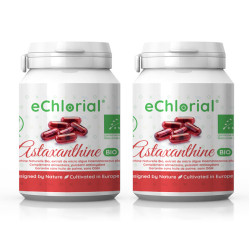
European Organic Astaxanthin
Trial Offer: Natural Organic Astaxanthin (2 months) 60
59.99
€ 55.99