

They are in your tap water, in your nonstick pan, in the sea salt you sprinkle on your pasta. PFAS—per- and polyfluoroalkyl substances, nicknamed “forever chemicals”—and microplastics have become two of the most widespread contaminants in our environment…and our bodies in just a few
decades.
The question everyone is asking is simple: can we get rid of them? And if so, how?
Intruders that are here to stay
PFAS, “forever pollutants”
PFAS include more than 10,000 man-made chemicals manufactured since the 1940s, found in pan coatings, food packaging, waterproof textiles, firefighting foams, and more.
What do they have in common? An exceptionally stable carbon-fluorine bond. The direct consequence is that these molecules hardly degrade at all, either in the environment or in the human body. Some have an estimated biological half-life of several years. Biomonitoring studies available in Europe indicate that PFAS are detectable in the blood of the vast majority of adults in industrialized countries.
Microplastics: when plastic breaks down and invades our lives
Microplastics are plastic particles smaller than 5 mm, resulting from the degradation of plastic waste or directly present in certain products. They have been found in the lungs, blood, placenta, breast milk, and even the human brain. A study published in 2024 in the New England Journal of Medicine established a link between the presence of microplastics in arterial plaques and an increased cardiovascular risk—a warning sign taken very seriously by the scientific community.
What they do in the
body
PFAS accumulate mainly in the liver, blood, and kidneys, with documented effects: endocrine disruption, immunotoxicity (reduced vaccine response observed in children), metabolic effects, and cancer risk for certain compounds (PFOA and PFOS classified as probable carcinogens by the IARC).
For microplastics, research is more recent, but the signs are accumulating: chronic inflammation, oxidative stress, and disruption of the gut microbiota. They also act as vectors for other contaminants—microplastics concentrate persistent organic pollutants, including PFAS themselves, on their surface.
Can these substances be eliminated from the body?
The honest answer is yes, partially, but not easily.
The liver excretes some PFAS in bile, the kidneys eliminate certain compounds in urine, and feces are the main route of elimination for ingested microplastics. But these mechanisms are slow in the face of chronic and continuous exposure.
Above all, a large proportion of the PFAS excreted in bile is reabsorbed in the intestine before reaching the stool: this is the enterohepatic cycle, a circuit that significantly slows down natural elimination.
On the medical side, approaches such as apheresis (blood filtration) and cholestyramine (a medicinal resin that interrupts the enterohepatic cycle) are the subject of active research—but remain medicalized or experimental. For most of us, the challenge is above all to limit daily accumulation.
The key role of dietary fiber
This is where diet comes into play in a concrete way.
Dietary fiber acts as an intestinal sensor: it can adsorb certain PFAS excreted in bile before they are reabsorbed, accelerate intestinal transit, and strengthen the intestine’s barrier function via the microbiota. The analogy with the drug cholestyramine is not insignificant—fiber is a natural, everyday version of this drug.
Fibers such as pectin (apples, citrus fruits), psyllium, and oat beta-glucans have shown measurable adsorption capacity for persistent organic pollutants in vitro.
⚠️ Clinical studies specific to PFAS are still limited, but the mechanism is biologically consistent and the general benefits of a high-fiber diet are well established.
The best sources are legumes, oat bran, apples and citrus fruits, psyllium seeds, and whole grains. Target: 25 to 30 g of fiber per day (the French average is only around 18 g).
Chlorella: the best-documented tool for going further
Among the natural sensors studied by researchers, one microalgae stands out for its solid scientific background: chlorella.
A remarkable composition
Chlorella (Chlorella vulgaris) is a single-celled microalgae whose cell wall — composed mainly of sporopollenin, an extremely resistant natural polymer — has documented adsorption properties. It also contains ~50-60% protein, a high concentration of chlorophyll, various antioxidants, and active fiber.
What science has proven
The literature
on heavy metals is convincing. Preclinical studies show that chlorella reduces the intestinal absorption of cadmium, mercury, and lead, decreases their accumulation in tissues, and increases their fecal excretion. Human data supports this, particularly for mercury in populations exposed through fish consumption.
What about PFAS and microplastics?
Specific
clinical studies do not yet exist—let’s be transparent about that. But its fibers and sporopollenin can theoretically capture organic molecules in the intestine, and its fiber density contributes to the mechanisms of interrupting the enterohepatic cycle described above.
Chlorella cannot be presented as a treatment for PFAS or microplastics. But it fits perfectly into an overall daily detoxification strategy: proven for heavy metals, biologically consistent for new persistent pollutants.
Good daily habits
Reducing exposure at the source remains the most powerful lever:
- Filter water (activated carbon filter or reverse osmosis)
- Avoid plastic containers for hot or fatty foods
- Choose stainless steel, glass, or cast iron over nonstick coatings Vent
- ilate regularly (PFAS attach to dust)
Supplement with a protective diet:
- Aim for 25-30 g of fiber per day
- . Maintain a healthy microbiota (fermented foods, prebiotics)
- . Stay hydrated.
Support with chlorella: 3 to 5 g per day in addition to a protective diet—be sure to choose a traceable, high-quality product with available contaminant analyses.
Key takeaways
True detoxification is not a three-day juice cleanse. It is a sustainable prevention strategy, built meal by meal — with the right natural tools to support it. Dietary fiber is a first line of intestinal defense that is too often neglected. And among the supplements available, chlorella stands out for its solid scientific backing and composition, making it a logical ally in a daily detoxification program to combat the persistent pollutants of our time.
Ultra Pure Organic Chlorella – Family Pack
Premium
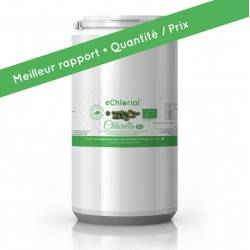
Chlor
ella – (10 months) 2000 tablets
$214.99
$194.99
now